

4 September 2026
News
Prague is in clear need of a new music centre. The city’s current concert halls – the Smetana Hall in the Municipal House and the Rudolfinum Dvořák Hall – are historically, architecturally and culturally significant. However, they no longer meet the demands of the 21st century when it comes to acoustics, capacity or modern facilities. The last concert hall to be built in Prague was completed over 100 years ago – a striking deficit compared to other European capitals.
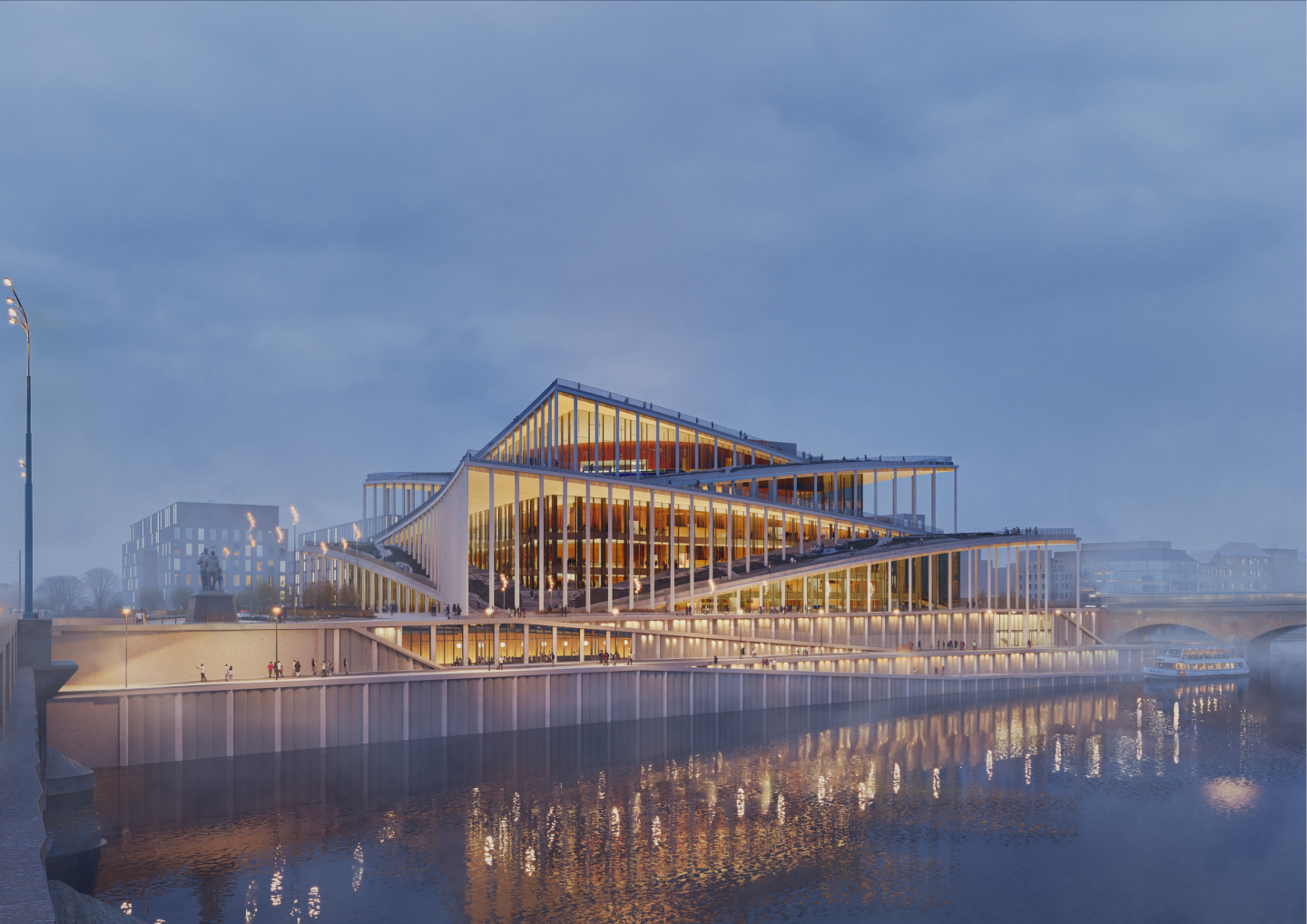
But the importance of this project extends well beyond the cultural sphere. The new national music centre will spark the revitalization of one of the largest and most neglected urban areas in Prague. The architecturally outstanding building, designed for all-day and year-round use, will spark urban regeneration and attract culture, public life and further investment to the area.
This is not a case of “wasting money”, but a strategic investment in the future. The new music centre will enhance Prague’s international prestige, help maintain its position as one of Europe’s cultural capitals and provide a modern musical venue that the city currently lacks. The need for a new concert hall has been discussed since the 1930s, and continued political support down the generations shows that this is not a fleeting idea, but a long-standing, repeatedly reaffirmed goal.
No, they certainly won’t end up empty. The demand for concerts in Prague has long exceeded supply. The relocation of the Czech Philharmonic and the Prague Symphony Orchestra (FOK) to the new building will free up space in the Municipal House and the Rudolfinum for smaller ensembles and festivals, which currently struggle to find venues in Prague. This will actually expand the city’s cultural opportunities and enrich its vibrant arts scene.
Annual attendance is expected to reach at least 1.3 million visitors. Approximately 680,000 people will attend concerts and cultural events, while hundreds of thousands more are anticipated to use the music library, rehearsal spaces, recording studios, restaurants and cafés. There is also expected to be strong public interest in guided tours and the rooftop viewpoint, which will make the building accessible to the general public – even outside of concert programming.
No, Prague 7 will not become an overcrowded tourist hotspot. Attendance estimates – based on real data from other concert halls across Europe – indicate that visitor flow will be evenly spread over time and space. Rather than a sudden influx like during a summer festival, the venue will host a steady cultural programme with balanced attendance throughout the year.
International visitors attending concerts are expected to stay throughout the city – not concentrated in a single district. Thanks to Vltavská’s excellent public transport connections, visitors can easily travel to and from the Philharmonic Hall, returning to their accommodation or exploring other parts of Prague after an event. Many concertgoers may come just for a performance and return home straight away.
No, Prague 7 will not become an overcrowded tourist hotspot. Attendance estimates – based on real data from other concert halls across Europe – indicate that visitor flow will be evenly spread over time and space. Rather than a sudden influx like during a summer festival, the venue will host a steady cultural programme with balanced attendance throughout the year.
International visitors attending concerts are expected to stay throughout the city – not concentrated in a single district. Thanks to Vltavská’s excellent public transport connections, visitors can easily travel to and from the Philharmonic Hall, returning to their accommodation or exploring other parts of Prague after an event. Many concertgoers may come just for a performance and return home straight away.
The estimated construction costs for the Vltava Philharmonic Hall amount to CZK 12.32 billion. However, the total planned investment by the City of Prague in this area will reach CZK 17.4 billion, as the project includes not only the building itself, but also related transport infrastructure and improvements to the surrounding environment.
Currently, the City of Prague is covering all project preparation costs, while negotiations with the national government regarding its involvement are ongoing. A dedicated Vltava Philharmonic Hall Endowment Fund has also been established, allowing both large and small donors to contribute – making participation possible for practically anyone.
According to the 2024 operational and financial model, the investment by both the city and the central government is expected to pay off. Over the first twenty years, the model projects an increase in public revenues of approximately CZK 29 billion, which is about 1.8 times the original investment.
Yes, the operation of the Vltava Philharmonic Hall will be financially self-sustaining and it will not require subsidies. The main source of revenue will come from renting out concert halls and other spaces, including long-term leases to resident organizations. The economic model is designed similarly to that of the Municipal House, which makes a profit today – and the Philharmonic’s finances are projected to be equally sustainable.
Vltavská is ideal for several reasons. It offers excellent transport accessibility – not only by car, but also by public transit. The site is directly connected to the metro, tram lines and the newly opened Praha–Bubny railway station. In the future, the river could also accommodate a stop for river trams.
The riverside plot continues the tradition of situating important buildings along the Vltava – from the National Theatre to the Rudolfinum. The Philharmonic Hall building will thus become a natural part of the city’s cultural axis, offering unique views of Prague Castle and the city’s skyline.
Finally, Vltavská currently functions mostly as a neglected transport hub. The new concert hall will serve as a catalyst for transforming the entire Bubny–Zátory brownfield site into a vibrant modern urban district full of life.
The new concert hall will be a landmark in Prague 7, but will definitely not be the tallest building. For example, the Church of St. Anthony on Strossmayerovo náměstí will remain significantly taller. The architects have carefully considered the context of the surrounding buildings and Prague’s skyline, thoughtfully working with both the building’s height and the layered design of its rooftop terraces. Starting with the architectural design competition, we have continuously assessed how the building fits into distant views of the city.
Yes, the Vltava Philharmonic Hall project places great emphasis on greenery and actively contributes to cooling the area and improving the microclimate. Compared to the original competition proposal, greenery in the area has been significantly expanded.
Greenery will be distributed both at ground level and directly on the building. The rooftop terraces will function as a linear green park, allowing visitors to walk seamlessly from the riverbank upward and experience the city and the river from various levels. The space between the building and the Vltava River will be complemented by a recreational meadow and an adjacent water feature; more trees will also be added toward Bubenská Street. A total of 78 new trees are planned (52 in open ground and 26 on the building’s structure), supplemented by shrubs, perennials, and climbing plants.
Additional measures will also play an important role, such as using heat-reflective materials for surfaces, misting elements and rainwater management systems. The planting scheme is inspired by the natural vegetation along the Vltava, helping to connect the building organically to both the river and the urban environment. As a result, an area currently dominated by asphalt and concrete will be transformed into a lively public space filled with trees, green space and a pleasant microclimate.
Bird protection is a natural and important part of the Vltava Philharmonic Hall’s design. The building is being constructed near a major bird migration corridor along the Vltava River, which is why the architects have been collaborating with the Czech Ornithological Society from the outset and have incorporated their recommendations directly into the design. The goal is to minimize the risk of bird collisions with the building and disturbance during their migration.
This is reflected in a number of specific measures, such as recessed and curved facades that reduce dangerous reflections, a higher proportion of opaque surfaces in high-risk areas, and opaque railings. The design of the landscaping and lighting is intended to avoid attracting birds to the facades and disturbing them at night. Together, these measures help ensure that the philharmonic hall becomes a safe part of the environment where birds naturally occur.
The Vltavská area already has excellent connections to public transport, and this accessibility will be maintained with the construction of the Vltava Philharmonic Hall. In the immediate vicinity, there is a metro station, tram lines, the newly opened Praha-Bubny railway station and plans for a future river tram stop. Cyclists are also considered, and there will be high-quality bike paths along the river and into the city.
The current capacity for car traffic will be fully preserved thanks to a solution based on the winning design. Drivers will turn off from Hlávka Bridge onto a right-turning ramp leading into a tunnel by Nábřeží Kapitána Jaroše, continuing onto Argentinská and beyond.
The chosen design and technical solution effectively connects the city with the river, creating a pleasant public space. It also allows, should traffic on the north-south expressway decrease, for part of the tunnel to be opened towards the Vltava and repurposed for vibrant riverbank life.
No, nearby traffic will not affect the halls’ acoustics. The building is designed with a comprehensive system of noise and vibration isolation measures aimed at preventing vibrations and noise from entering the interior. The concert halls will feature a special box-in-box construction, complemented by additional soundproofing elements in the foundations and façade. Anti-vibration layers beneath the tracks – commonly used in cities with heavy traffic – are also part of the solution. Thanks to these measures, the halls will provide a calm environment with optimal acoustics, completely undisturbed by nearby traffic.
We are continuously adding questions.